Mackinac Island historic landmarks preserve centuries of Anishinaabe, French, British, and American history in northern Michigan. Forts, churches, homes, and civic buildings sit within walking or cycling distance of the ferry docks.
The island restricts private motor vehicles, so visitors explore by foot, bicycle, or horse-drawn carriage. This slower pace makes it practical to notice original stonework, period interiors, and views that shaped Mackinac’s development.
Essential Mackinac Island Historic Landmarks
Most major sites stand in or near the downtown historic district. Mackinac State Historic Parks manages many of them and offers seasonal tours, demonstrations, and exhibits.
Fort Mackinac
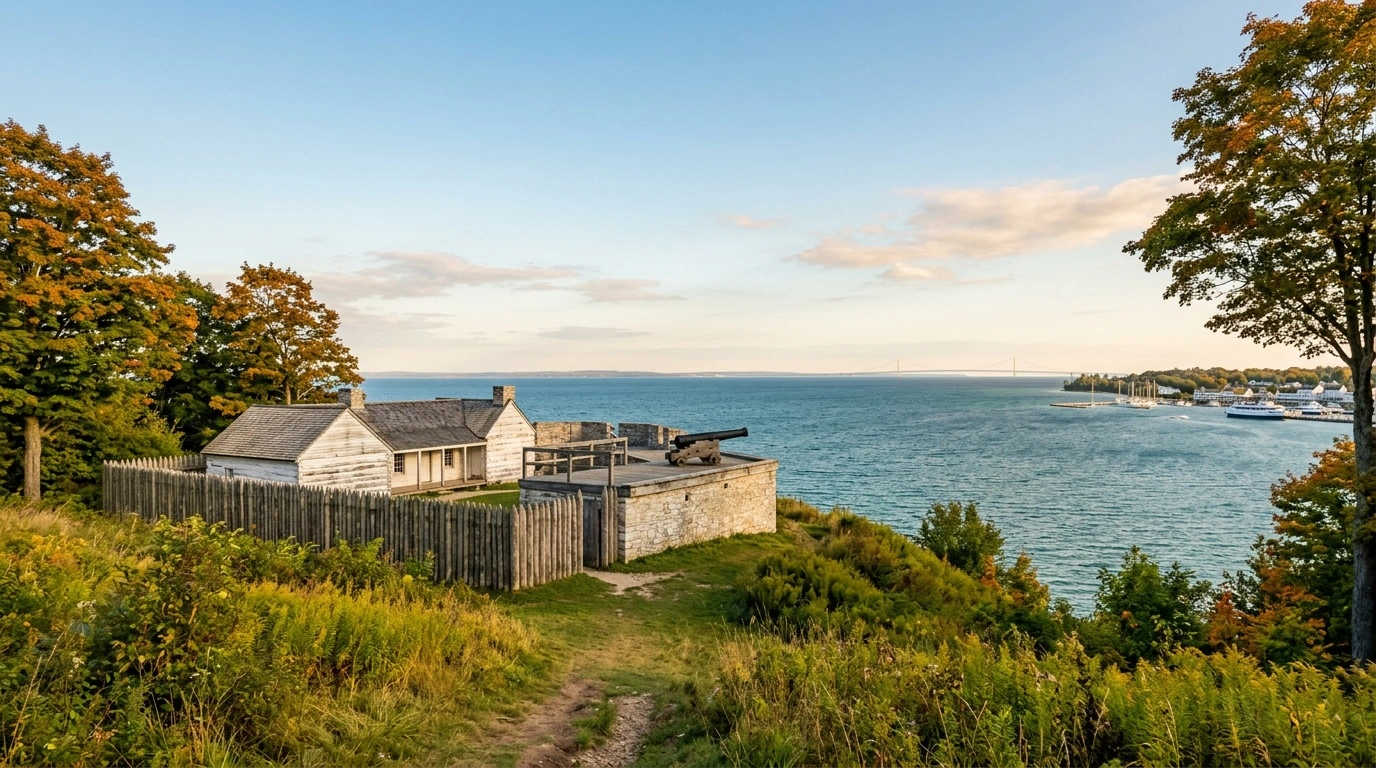
British soldiers established Fort Mackinac in 1780 during the American Revolution. They chose the limestone bluff for its clear view of the Straits of Mackinac.
American forces took control in 1796, lost the fort during the War of 1812, and regained it after the war. The U.S. Army remained there until 1895.
Today, visitors can enter original military buildings, watch historical demonstrations, and study exhibits about island life. The fort’s location also provides a broad view of the harbor and Mackinac Bridge.
Fort Holmes
Fort Holmes occupies the island’s highest point, about 320 feet above Lake Huron. British troops built the original earthwork in 1814 and named it Fort George.
American forces later renamed it for Major Andrew Hunter Holmes, who died during the Battle of Mackinac Island. A reconstructed blockhouse now marks the site.
The climb requires more effort than the walk to Fort Mackinac. However, the quiet setting and military history make it a worthwhile stop for prepared walkers and cyclists.
Mission Church
Mission Church dates to 1829 and ranks among Michigan’s oldest surviving church buildings. Protestant missionaries constructed it near their school and religious settlement.
The plain New England design contrasts with the island’s later Victorian architecture. Inside, simple wooden pews and period details reflect the church’s early purpose.
The building also connects to author Constance Fenimore Woolson, who set part of her 1880 novel Anne on Mackinac Island. Check current opening hours before visiting, since access may vary by season.
Biddle House and the Mackinac Island Native American Museum
The Biddle House dates to the early 1800s, when Mackinac supported a major Great Lakes fur-trade community. Merchant Edward Biddle lived there with his wife, Agatha, an Anishinaabe woman and business partner.
The restored house now contains the Mackinac Island Native American Museum. Its exhibits center Anishinaabe history, culture, and continuing connections to the island.
Interpreters explain how Native kinship networks and labor supported the regional fur trade. The site adds essential context to stories often told through military officers and European merchants.
McGulpin House
McGulpin House shows how working residents lived during Mackinac’s early trading era. Builders likely constructed the small dwelling before 1780, making it one of Michigan’s oldest surviving homes.
Its squared-log walls reveal French Canadian building methods rarely seen in the region today. Visitors can inspect the compact rooms and learn how historians study early structures.
American Fur Company Store and Dr. Beaumont Museum
This downtown building once served the American Fur Company, which dominated the regional trade during the early 1800s. It later became associated with Dr. William Beaumont’s research into human digestion.
Beaumont treated fur trader Alexis St. Martin after an accidental gunshot wound left an opening in his stomach. Their controversial experiments produced influential observations about digestion.
The museum covers both the medical research and the building’s commercial history. Exhibits also address the ethical concerns surrounding Beaumont’s work with St. Martin.
Indian Dormitory
The federal government constructed the Indian Dormitory in the 1830s. Officials intended it to house Native people who traveled to the island for treaty payments and government business.
The building later served several purposes, including use as a school and public museum. Its history reflects federal policies that disrupted Native communities across the Great Lakes.
Exhibits place those policies within the island’s broader story. Visitors should allow time to read the interpretation rather than treating the building as a brief photo stop.
Landmarks Beyond the Downtown Streets
British Landing and the 1814 Battlefield
British Landing marks the place where British forces came ashore in July 1812. They crossed the island and captured Fort Mackinac without a battle.
Two years later, American troops landed nearby during an unsuccessful attempt to retake the island. Fighting occurred inland at the Battle of Mackinac Island site, where Major Holmes died.
A paved road and cycling route connect downtown with British Landing. Historical markers explain the military actions and identify key locations along the way.
Grand Hotel
Grand Hotel opened in 1887 as rail and steamship companies promoted Mackinac Island as a summer destination. Its long porch and white facade became defining features of the island’s resort era.
The hotel remains a working private resort, and non-guests may need to pay an admission fee to enter designated areas. Confirm current access rules before planning a visit.
Even without entering, travelers can view the property from public roads and nearby paths. The surrounding cottages also illustrate the growth of seasonal tourism during the late 19th century.
Round Island Lighthouse
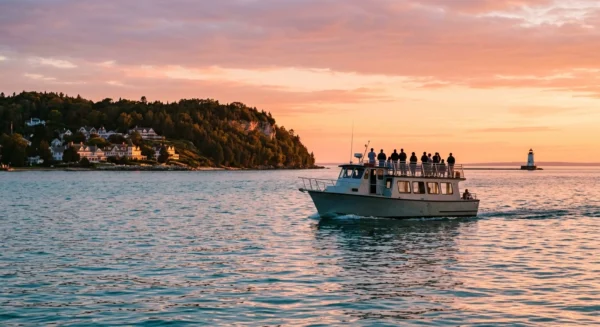
Round Island Lighthouse stands across the channel from Mackinac Island. The federal government completed the red-and-white structure in 1895 to guide vessels through the straits.
Visitors can see it clearly from the ferry route and the island’s southern shoreline. Public access to Round Island remains limited, so most travelers view the lighthouse from a distance.
Planning a Historic Walking Route
A practical route begins downtown at Biddle House, McGulpin House, and the Beaumont Museum. Continue uphill to Fort Mackinac, then follow the road toward Mission Church.
Travelers with more time can cycle to British Landing and climb to Fort Holmes. This route covers many Mackinac Island historic landmarks without repeated trips through downtown.
Wear supportive shoes because steep grades and uneven surfaces appear around the forts. Bring water, especially during warm summer afternoons.
Many museums operate seasonally, and schedules can change for private events or maintenance. Review official Mackinac State Historic Parks information before departure.
Understanding Mackinac Island Through Its Landmarks
The island’s buildings tell connected stories about military strategy, commerce, tourism, and Native persistence. No single site explains that history on its own.
Fort Mackinac provides the military record, while Biddle House and the Indian Dormitory add cultural and political context. Mission Church, McGulpin House, and Grand Hotel show how architecture changed as the island moved from trade center to resort community.
Visiting several Mackinac Island historic landmarks creates a fuller account of the people who lived, worked, negotiated, and traveled here. Take time with the exhibits, historical markers, and original structures rather than rushing between photo stops.